Intermittent Fasting: What Is It, How Does 16:8 Work, and Is It Effective?

Intermittent fasting is an eating pattern that alternates between periods of eating and fasting. The popular 16:8 method means eating within an 8-hour daily window and avoiding calorie-containing foods for the remaining 16 hours. Research suggests that time-restricted eating may help some adults lose weight and improve certain metabolic markers, but it is not a guaranteed or universally superior approach to weight loss.
Intermittent fasting has become one of the most widely discussed approaches to weight management. Unlike many traditional diets, it focuses primarily on when you eat rather than prescribing a specific list of foods.
That simplicity is part of its appeal. Instead of counting every calorie or eliminating an entire food group, you establish a daily eating window and try to keep meals within it.
But there is an important distinction between an attractive social-media claim and what the evidence actually shows.
Intermittent fasting is not a magic fat-burning method, and fasting does not make unlimited amounts of unhealthy food harmless. The quality of the diet, total energy intake, physical activity, sleep and individual health all remain important.
What Is Intermittent Fasting?
Intermittent fasting, often abbreviated as IF, is a dietary pattern in which eating is restricted to particular periods of time.
One of the most common forms is time-restricted eating (TRE). Instead of eating throughout a long portion of the day, a person limits food intake to a consistent daily window, such as 8, 10 or 12 hours.
For example:
8:00 a.m. – 8:00 p.m. → 12-hour eating window
8:00 p.m. – 8:00 a.m. → 12-hour fasting window
Or with a stricter schedule:
12:00 p.m. – 8:00 p.m. → 8-hour eating window
8:00 p.m. – 12:00 p.m. → 16-hour fasting window
The second example is the familiar 16:8 intermittent fasting method.
The goal isn’t necessarily to eat fewer types of foods. Instead, the approach changes the amount of time available for eating.
What Is the 16:8 Intermittent Fasting Method?
The 16:8 method divides a 24-hour day into:
- 16 hours of fasting
- 8 hours of eating
A simple example is eating between 12 p.m. and 8 p.m. and fasting from 8 p.m. until noon the following day.
Another person might prefer 10 a.m. to 6 p.m.
There is no universal requirement that everyone use exactly the same hours.
In fact, research into time-restricted eating has used different eating windows. A 2024 randomized controlled trial involving adults with metabolic syndrome used personalized 8- to 10-hour eating windows, with the eating period beginning at least one hour after waking and ending at least three hours before sleep.
This suggests that the concept is more flexible than many social-media graphics imply.
Popular Types of Intermittent Fasting
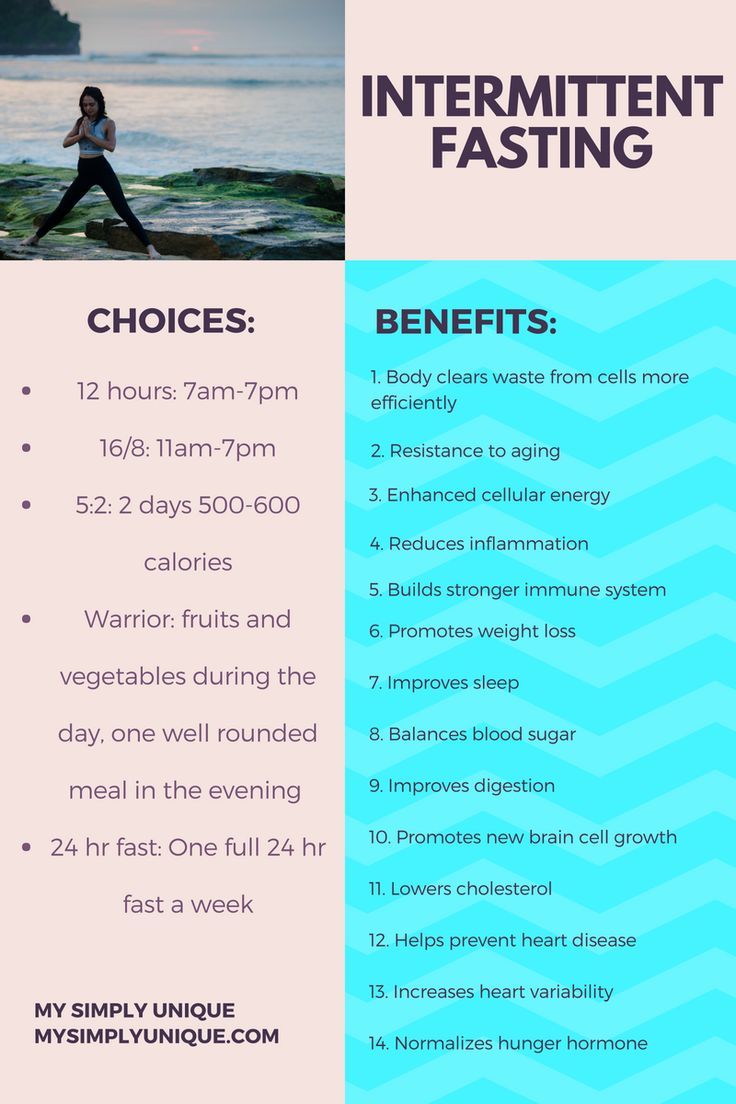
1. 16:8 Intermittent Fasting
This is one of the simplest approaches.
You eat during an 8-hour period and fast for the other 16 hours.
Example:
- 12:00 p.m. — first meal
- 3:30 p.m. — optional snack
- 7:00 p.m. — dinner
- 8:00 p.m. — fasting begins
2. 14:10 Intermittent Fasting
This provides a 10-hour eating window and a 14-hour fasting period.
It may be a more comfortable starting point for someone who finds 16:8 difficult.
3. 5:2 Fasting
The 5:2 approach typically involves eating normally on five days and substantially restricting energy intake on two days.
This is different from daily time-restricted eating and should not be treated as interchangeable with 16:8.
4. Longer Fasting Periods
Some people practice 24-hour or longer fasts.
Longer fasting periods are not necessary for everyone, and they may be harder to maintain or inappropriate for certain people. There is no reason to assume that a longer fast automatically produces better results.
How Does Intermittent Fasting Work?
During a fasting period, the body does not receive energy from food, so it relies increasingly on stored energy.
This is one reason intermittent fasting has attracted attention in obesity and metabolic research.
However, it is important not to oversimplify the process.
Weight loss still depends heavily on overall energy balance. If a shorter eating window simply causes someone to consume fewer calories, weight may decrease. If the person compensates by eating very large meals during the eating window, the expected weight-loss effect may be much smaller.
Research reviews have found that intermittent energy restriction can produce weight loss, but it has not consistently demonstrated a major advantage over continuous calorie restriction.
In other words, the clock may be useful, but the clock is not the whole diet.
Can Intermittent Fasting Help You Lose Weight?
Yes, intermittent fasting can help some people lose weight, but it does not guarantee weight loss.
A major advantage may be practical rather than magical: limiting the hours available for eating can make it easier for some people to reduce their overall food intake.
A 2024 meta-analysis of randomized controlled trials found that early time-restricted eating was associated with reductions in body weight, fat mass and waist circumference compared with non-time-restricted eating.
Another 2024 review described time-restricted eating as a potentially useful strategy for obesity management, while emphasizing the need to consider the available clinical evidence rather than treating it as a universal solution.
The most useful takeaway is therefore:
Intermittent fasting can be a tool for weight management, but it is one option among several—not a requirement for successful weight loss.
What Does the Latest Research Say?
The evidence is promising but should be interpreted carefully.
In a 2024 randomized controlled trial, adults with metabolic syndrome followed standard nutritional counseling or nutritional counseling combined with an individualized 8- to 10-hour time-restricted eating schedule.
After three months, the time-restricted eating group experienced modest improvements in HbA1c and reductions of approximately 3% to 4% in body weight, BMI and trunk fat. The average weight loss was about 6.6 pounds, and researchers reported that the loss was primarily fat rather than lean mass.
That is interesting—but it does not mean everyone using 16:8 will lose 6.6 pounds.
The study population, duration, eating schedule and individual circumstances matter.
The researchers also emphasized that longer and larger clinical trials are needed to understand the long-term benefits and potential drawbacks of time-restricted eating.
What Are the Potential Benefits of Intermittent Fasting?
Research has investigated several possible benefits.
Weight management
Restricting the eating window may help some people reduce overall energy intake and lose weight.
Blood glucose control
Some studies have reported improvements in measures of glucose regulation. In the 2024 metabolic-syndrome trial, HbA1c improved modestly in the time-restricted eating group.
Waist circumference and body fat
Studies of early time-restricted eating have reported reductions in waist circumference and fat mass.
Eating structure
For some people, having a clear beginning and end to the eating day may reduce frequent snacking and make a routine easier to follow.
However, benefits vary between individuals.
Claims that intermittent fasting prevents aging, creates new brain cells, cures disease, dramatically boosts immunity or guarantees heart-disease prevention go beyond what can reasonably be concluded from current human evidence.
What Can You Eat During Intermittent Fasting?
Intermittent fasting does not make food quality irrelevant.
During your eating window, build meals around nutrient-dense foods such as:
- Vegetables
- Fruits
- Beans and lentils
- Whole grains
- Eggs
- Fish
- Lean meats
- Yogurt and other suitable dairy products
- Nuts and seeds
- Healthy sources of unsaturated fat
A balanced meal might look like:
Grilled chicken + roasted vegetables + brown rice + olive oil
Or:
Lentils + mixed vegetables + whole-grain bread + yogurt
For a plant-based option:
Tofu + broccoli + quinoa + avocado
The exact foods can vary according to dietary preferences, culture, allergies and individual nutritional needs.
What Can You Drink While Fasting?
During a fasting period, people commonly choose water and other calorie-free beverages.
Examples include:
- Water
- Sparkling water
- Unsweetened tea
- Unsweetened herbal tea
- Plain coffee
Adding sugar, honey, milk or cream introduces calories and therefore changes what “fasting” means in a strict sense.
The best choice for most people is simple: stay hydrated and avoid turning the fasting period into a cycle of sugary drinks.
Does Coffee Break a Fast?
Plain black coffee contains very few calories and is commonly included in intermittent-fasting routines.
However, adding sugar, flavored syrups, cream or substantial amounts of milk adds energy.
If fasting is being used for a specific medical purpose, follow the instructions provided by your healthcare professional rather than relying on general online fasting rules.
Common Intermittent Fasting Mistakes
Eating excessively during the eating window
A fasting period does not cancel out excessive calorie intake.
Ignoring protein
If weight loss is your goal, adequate protein and resistance exercise can be important for maintaining muscle.
Choosing mostly ultra-processed foods
A shorter eating window does not automatically make a low-quality diet healthy.
Not drinking enough fluids
Dehydration can make fasting feel much harder.
Starting too aggressively
You do not have to jump immediately into a 16-hour fast.
A 12-hour overnight period may be a simpler starting point for some adults.
Treating fasting as a competition
Longer fasting is not necessarily better.
A sustainable eating pattern is generally more useful than an extreme routine that you cannot maintain.
Is Intermittent Fasting Safe for Everyone?
No. Intermittent fasting is not appropriate for everyone.
Johns Hopkins Medicine advises against intermittent fasting for children and teenagers under 18, people who are pregnant or breastfeeding, people with type 1 diabetes who use insulin, and people with a history of eating disorders.
People who are underweight or who have certain medical conditions may also need to avoid fasting or use it only under professional supervision.
Anyone taking medication that depends on regular meals or that can affect blood glucose should discuss changes in meal timing with a healthcare professional.
Medical advice notice: If you have diabetes, are pregnant or breastfeeding, have a history of an eating disorder, are underweight, or take regular medication, speak with a doctor or registered dietitian before starting an intermittent-fasting program.
Intermittent Fasting and Exercise
You can exercise while following a time-restricted eating schedule, but the ideal timing depends on the person and the type of exercise.
Some people feel comfortable exercising before their first meal. Others perform better after eating.
For strength training, endurance exercise or high-intensity workouts, pay attention to:
- Energy levels
- Hydration
- Protein intake
- Recovery
- Overall calorie intake
If fasting consistently causes dizziness, weakness, headaches or poor exercise performance, the schedule may need to be changed.
There is no health prize for completing a workout while severely hungry.
How to Start 16:8 Intermittent Fasting
If you want to experiment with time-restricted eating, start gradually.
Step 1: Establish a consistent dinner time
For example, finish dinner around 7:30 or 8 p.m.
Step 2: Avoid unnecessary late-night snacking
This may naturally create a longer overnight fasting period.
Step 3: Try a 12-hour overnight fast
For example:
8 p.m. → 8 a.m.
Step 4: Extend the fasting period if it feels appropriate
You could later experiment with 14:10 or 16:8.
Step 5: Keep meals nutritious
Do not sacrifice protein, vegetables, fiber or micronutrients simply to make the fasting window longer.
Step 6: Monitor how you feel
Persistent dizziness, severe hunger, headaches, anxiety or other concerning symptoms are reasons to stop and seek professional advice.
Is 16:8 Better Than Other Diets?
Not necessarily.
The best eating pattern is often the one that fits a person’s health needs, preferences, schedule and ability to maintain it over time.
Intermittent fasting may work particularly well for someone who prefers fewer eating occasions and dislikes calorie counting.
Someone else may prefer three regular meals.
Both approaches can potentially support healthy weight management when overall dietary quality and energy intake are appropriate.
The current evidence does not justify presenting 16:8 as universally superior to other evidence-based approaches.
Frequently Asked Questions
How many hours should you fast for intermittent fasting?
Common schedules include 12:12, 14:10 and 16:8. There is no requirement that everyone fast for 16 hours.
Can you drink water during intermittent fasting?
Yes. Water is generally appropriate during fasting and is important for hydration.
Can you lose belly fat with intermittent fasting?
Intermittent fasting may contribute to overall weight and fat loss, but it cannot selectively target belly fat. Where the body loses fat first varies between individuals.
Does 16:8 fasting work for weight loss?
It can help some people lose weight, particularly if the shorter eating window leads to lower overall energy intake. However, results vary and 16:8 is not guaranteed to outperform other sustainable weight-loss strategies.
What should I eat after fasting?
A balanced meal containing protein, vegetables or fruit, a high-fiber carbohydrate source and a suitable fat source is a practical choice.
Can I drink coffee while fasting?
Plain black coffee is commonly used during fasting. Calorie-containing additions such as sugar, syrup and substantial amounts of milk change the nutritional definition of the fast.
Is intermittent fasting safe?
It can be safe for many adults, but it is not appropriate for everyone. Children and teenagers, pregnant or breastfeeding people, people with type 1 diabetes using insulin and people with eating-disorder histories should avoid it or seek specific medical guidance.
Does intermittent fasting boost metabolism?
It is too simplistic to say that intermittent fasting simply “boosts metabolism.” Human studies have found changes in body weight and several metabolic markers, but the effects depend on the fasting pattern and individual circumstances.
Conclusion
Intermittent fasting is best understood as a meal-timing strategy, not a miracle diet.
The popular 16:8 method can provide a simple structure for people who prefer a defined eating window. Current research suggests that time-restricted eating may support modest weight loss and improvements in some metabolic measures, but the evidence does not show that fasting is automatically better than every other approach to healthy weight management.
The most effective version is therefore unlikely to be the most extreme one.
Instead, focus on a routine you can maintain while eating nutritious foods, getting adequate protein and fiber, staying hydrated, exercising regularly and getting enough sleep.
And if you have a medical condition, take medication, are pregnant or breastfeeding, or have a history of disordered eating, get individualized medical or dietetic advice before changing your eating schedule.